Employee, Worker, or Contractor? Getting Your Employment Status Right (and What IR35 Means for You)
- gavynhuzzey
- Dec 13, 2025
- 4 min read
Updated: Dec 29, 2025
You're a small business owner. You hire people to help your company grow. Easy, right? Not always. How you classify the people who work for you is a crucial decision that affects everything from their rights to your tax bill. Get it wrong, and you could face expensive claims and penalties from HMRC. Let's break down the three main types of employment status and discuss how the infamous IR35 rules might affect you.
The Three Tiers of Employment Status
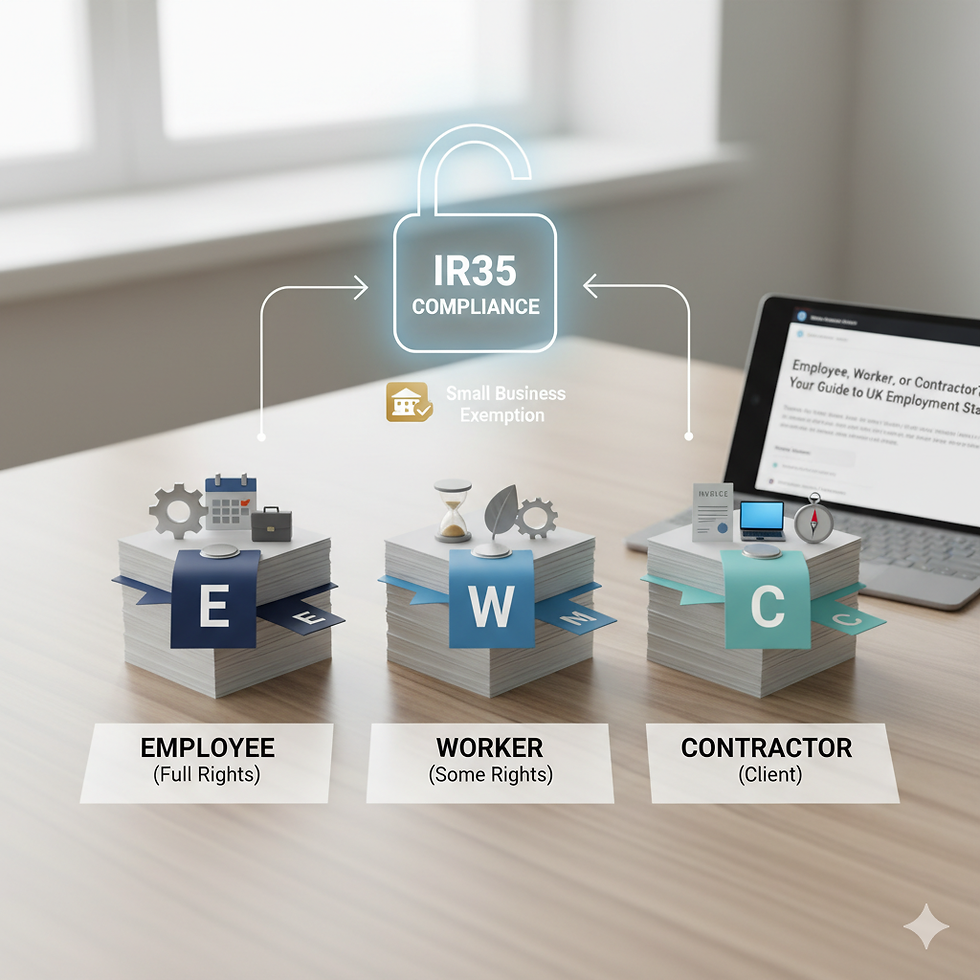
When you engage someone to perform a service, they fall into one of three categories, each with different legal rights.
1. The Employee (The Most Rights)
An employee is a fully integrated member of your business. They have a "contract of employment" and enjoy the full suite of employment rights. They likely have a company email address and work defined hours or patterns. The key characteristics of an employer-employee relationship are:
Control: You dictate how, when, and where the employee works.
Substitution: The employee must do the work themselves and cannot appoint a substitute.
Mutuality of Obligation: You are obliged to offer work and the employee is obliged to accept it.
Employees have key rights including protection against unfair dismissal (after a qualifying period of service), redundancy pay, paid sick leave (SSP), paid parental leave, and the right to request flexible working.
2. The Worker (Some Rights)
This is the middle ground, often applying to casual staff, zero-hours contractors, or some agency workers. They have fewer rights than an employee but more than a self-employed contractor. The key characteristics of an employer-worker relationship are:
Control: You have some control over the work performed by the worker, but less than with an employee.
Substitution: Workers generally must perform the work themselves.
Mutuality of Obligation: You may not be obliged to offer work and the worker may not be obliged to accept work offered.
Workers have more limited rights than employees but they do have a right to the National Minimum Wage, paid annual leave, and protection against unlawful deductions from wages (among others).
3. The Self-Employed/Contractor (Contractual Rights Only)
This person is running their own business and is a client of yours. They have the least protection under employment law. The key characteristics of a client-contractor relationship are:
Control: A contractor decides how, when, and where they do the work.
Substitution: A contractor typically has a genuine right to appoint a suitably qualified substitute to perform the work.
Mutuality of Obligation: You have no obligation to offer work and the contractor has no obligation to accept work.
Crucially, a contractor will invoice a client for their services and is responsible for their own tax and National Insurance Contributions (NICs).
Your Compliance Check: The IR35 Rules & The New Small Business Thresholds
IR35 (formally known as the 'off-payroll working rules') is a set of tax rules designed to stop "disguised employment" where a contractor works like an employee but uses an intermediary such as a limited company (sometimes called a personal service company (PSC)) to reduce their tax bill. For private sector companies, the key question is: Are you a small business? If you are, you're exempt from the administrative burden of operating IR35. This means that the responsibility for determining the contractor's status stays with the contractor's PSC.
The New "Small Business" Thresholds (Effective April 2025)
The definition of a "small business" has been updated for accounting periods beginning on or after 6 April 2025. This is great news, as it means many growing companies will now qualify for the exemption. To qualify as a "small business," you must meet two or more of the following conditions for two consecutive financial years:
Criteria | New Threshold (From April 2025) | Previous Threshold |
Annual Turnover | Not more than £15 million | Not more than £10.2 million |
Balance Sheet Total | Not more than £7.5 million | Not more than £5.1 million |
Average Number of Employees | Not more than 50 | Not more than 50 |
A Crucial Timeline for Currently Medium-Sized Businesses
If your business was previously classified as "medium" but now meets the new "small" thresholds, you need to understand the timing of the change. The two consecutive financial years rule for being classified as "small" for IR35 means the change won't be immediate:
Example: If your company's financial year ends in December, and you meet the new "small" criteria for the years ending 31 December 2025 and 31 December 2026, the earliest your IR35 responsibility will revert to your contractors is the tax year beginning 6 April 2027.
If you’re a growing business that now meets the new "small" criteria, you must continue to apply the IR35 rules (i.e., you remain responsible for the status determination) until the start of the tax year following the filing deadline for your second consecutive qualifying year. Plan ahead!
Actionable IR35 Compliance Checklist
Whether you are responsible for the assessment or the contractor is, these steps help everyone stay compliant:
Look Beyond the Contract: HMRC will always look at the reality of the working arrangements, not just what your contract says. If the contract grants a right of substitution, but you'd never actually allow it, the arrangement is likely "Inside IR35."
Use the Key Tests: When engaging a contractor, ask yourself these three core questions (the same ones courts use):
Control: How much say do we have over how they do the work? (Less control = more likely outside IR35).
Substitution: Do they have a genuine, unfettered right to appoint a qualified substitute? (Right to substitute = more likely outside IR35).
Mutuality of Obligation: Are we obliged to offer them work, and are they obliged to accept it? (Absence of mutuality of obligation = more likely outside IR35).
Check Your Size & Notify: Regularly review your financials against the new thresholds. If you shift from "medium" to "small," you must inform your contractors that they are now responsible for their own IR35 determination.
Document Everything: Keep detailed, auditable records of your company size and the working arrangements for every contractor.
Getting employment status wrong is a common, and expensive, mistake. Proactive legal advice and robust documentation are the best tools for navigating this complex area. If you're in any doubt, please do reach out!


Comments